

Agricultural feed transport vehicle
An agricultural feed transport vehicle is a specialized truck designed to move large quantities of animal feed efficiently, safely, and hygienically between production sites, storage locations, and farms. Its primary function is to protect feed quality while reducing handling time and labor costs. These vehicles are essential in modern livestock and poultry production, where consistent and timely delivery of feed directly influences animal health and productivity.The core component of this vehicle is the feed tank or hopper body, usually constructed from high‑strength steel or aluminum. The tank is divided into multiple compartments, allowing different types or formulations of feed to be transported simultaneously without cross‑contamination. Each compartment typically has individual discharge outlets to deliver precise amounts of feed to specific storage silos or bins. The interior surfaces are smooth and often coated or treated to reduce residue buildup and maintain feed hygiene.To unload feed, the vehicle is equipped with an integrated conveying system. Common systems include screw augers, pneumatic blowers, or a combination of both. The screw auger system moves feed mechanically through enclosed tubes, providing accurate control and minimizing dust. Pneumatic systems use air pressure to blow feed through hoses directly into elevated silos. These systems are designed to handle pellets, mash, and crumbled feed without significant damage to particle structure.The feed transport vehicle is built on a robust chassis, usually with multiple axles to support heavy loads and ensure stability on rural and uneven roads. Suspension, braking, and steering systems are reinforced to handle frequent starts, stops, and tight maneuvering in confined farmyards. The power from the truck engine is often used to drive the unloading equipment via a power take‑off (PTO) system, reducing the need for additional power units.Safety and environmental protection are important aspects of the vehicle’s design. Sealed tanks and covers prevent feed loss during transit and reduce dust emissions. Many vehicles are fitted with dust‑control features at the discharge points, such as filters or cyclones, to improve working conditions and comply with environmental standards. Non‑slip walkways, guardrails, and access ladders on the tank allow operators to inspect hatches and equipment safely.The driver’s cab is usually equipped with controls for the unloading system, allowing one operator to manage positioning, discharge rate, and compartment selection. In more advanced configurations, electronic weighing systems and automated controls record the amount of feed delivered to each destination, improving traceability and inventory management. Some vehicles also feature GPS and telematics for route optimization and real‑time monitoring of deliveries.Overall, the agricultural feed transport vehicle plays a crucial role in the feed supply chain, linking feed mills, central storage facilities, and farms. By combining high‑capacity transport with precise, hygienic unloading systems, it supports efficient livestock operations and helps maintain consistent feed quality from production to consumption.
Products
Category:
-
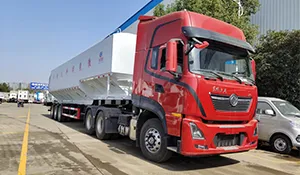
60-66 cubic meter semi-trailer feed truck
Category: Bulk feed truckBrowse number: 3Number:Release time: 2026-03-26 11:46:40The 60-66 cubic meter semi-trailer feed truck offers efficient bulk feed transportation with a robust design. Equipped with four high-power augers and hydraulic lifting systems, this truck can handle large volumes of feed. It features six independent compartments for precise load management, ensuring smooth and reliable discharge during transport.
News
Category:
No search results found!
Case
Category:
No search results found!
Video
Category:
No search results found!
Download
Category:
No search results found!
Job
Category:
No search results found!
Featured Products
No search results found!



 WhatsApp
 Phone
Phone