

agriculture feed logistics vehicle
An agriculture feed logistics vehicle is a specialized transport unit designed to move large volumes of animal feed efficiently, safely, and hygienically from production or storage sites to farms and feeding facilities. Its primary function is to ensure that livestock receive the right type and quantity of feed on time, while minimizing losses, contamination, and handling labor.Typically, the vehicle is built on a heavy-duty truck chassis capable of carrying substantial payloads over rural and often uneven terrain. The superstructure is usually a bulk feed body or a series of compartments that allow separation of different feed types, such as pellets, mash, minerals, or specialty rations. Each compartment can be loaded independently, enabling one vehicle to serve several customers or deliver multiple feed formulations in a single route.Loading is commonly done from overhead silos or production lines through gravity chutes or pneumatic systems. The interior surfaces of the compartments are smooth and often coated to prevent feed residue build-up and reduce the risk of mold or cross-contamination. Weather-resistant construction protects the cargo from moisture, sunlight, and pests during transportation.A key feature of this type of vehicle is its unloading system. Many feed logistics vehicles are equipped with augers, conveyors, or pneumatic blowers that transfer feed directly into farm silos, bins, or feeding systems. Flexible hoses and adjustable discharge spouts allow the driver to position the outlet precisely, even where space is limited. The unloading process is designed to be quick and controlled, reducing dust, spillage, and product damage.On-board weighing and metering equipment can provide accurate measurements of feed delivered to each customer. Electronic control panels, often integrated with GPS and route management software, help operators monitor load status, compartment levels, and delivery records in real time. This data supports traceability, inventory planning, and compliance with feed safety regulations.Safety is an important aspect of design. The vehicle usually includes robust braking systems, stability controls, and secure ladders or platforms for inspection and maintenance. Dust suppression features, such as filters and controlled airflow, protect both operators and animals from excessive airborne particles.From an operational standpoint, the agriculture feed logistics vehicle bridges the gap between feed mills, storage facilities, and farms. It allows centralized production of high-quality feed while ensuring timely distribution across a wide geographic area. By combining high payload capacity, precise delivery mechanisms, and modern tracking technology, this vehicle plays a crucial role in maintaining consistent nutrition for livestock, improving farm efficiency, and supporting sustainable agricultural supply chains.
Products
Category:
-
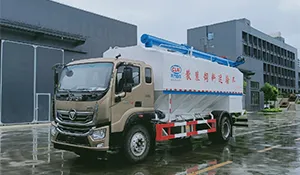
Foton Aoling bulk feed transport truck (20-24 cubic meters)
Category: Bulk feed truckBrowse number: 3Number:Release time: 2026-03-26 10:30:00The bulk feed transport vehicle is engineered for efficient feed delivery to livestock and poultry farms. Featuring multi-compartment tanks, electric or hydraulic augers, and high-capacity storage, it ensures precise, safe, and rapid feed distribution. Ideal for farms, feed mills, and regional feed distributors, it maximizes productivity while minimizing operational costs.
News
Category:
No search results found!
Case
Category:
No search results found!
Video
Category:
No search results found!
Download
Category:
No search results found!
Job
Category:
No search results found!
Featured Products
No search results found!



 WhatsApp
 Phone
Phone